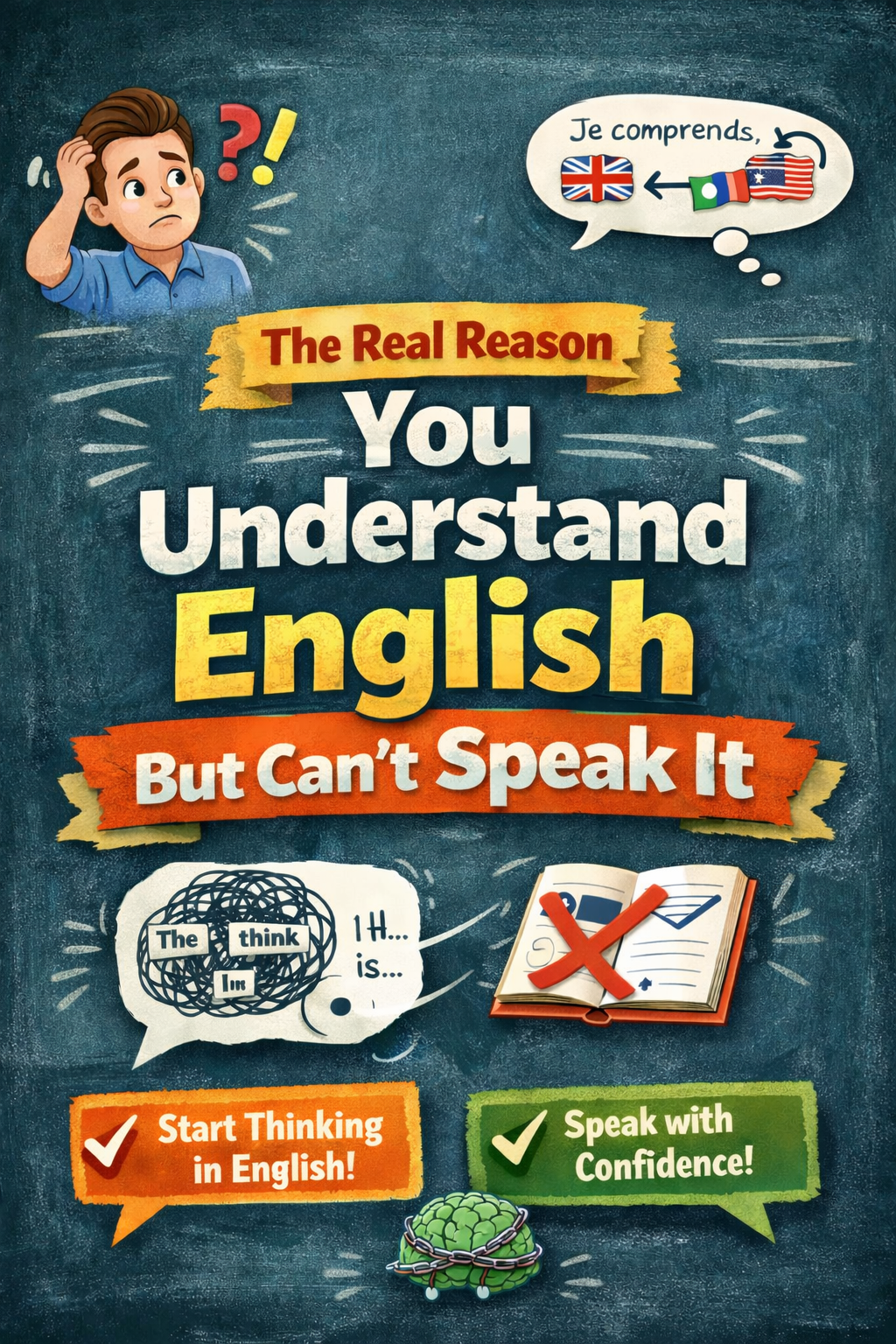
The Real Reason You Understand English but Can’t Speak It

Introduction
Many English learners have the same problem.
Publicité
You can understand English very well.
You can read articles, watch videos, follow movies, and understand teachers or native speakers.
But when you want to speak English, something strange happens.
You stop.
You hesitate.
Your mind feels empty.
You know the words.
You know the grammar.
But you cannot speak.
This situation is very frustrating. Many learners think:
- “My English is bad.”
- “I need more grammar.”
- “I don’t have enough vocabulary.”
- “I’m not confident.”
But the real reason is not a lack of knowledge.
The real reason you understand English but can’t speak it is how your brain learned English.
In this article, you will discover:
- Why understanding English is easier than speaking it
- The real mental block that stops you from speaking
- The role of translation, fear, and habits
- Why grammar and vocabulary are not the main problems
- Practical solutions to finally start speaking English
This article is written for intermediate learners who understand English but struggle to speak fluently and confidently.
1. Understanding English and Speaking English Are Different Skills
The first important thing to understand is this:
Understanding English and speaking English are not the same skill.
Understanding English is a passive skill
When you listen or read:
- English comes to you
- Your brain recognizes words
- You do not need to create sentences
You have time to think.
There is no pressure.
That is why many learners can:
- Understand YouTube videos
- Follow movies without subtitles
- Understand conversations between other people
Speaking English is an active skill
When you speak:
- You must choose words
- Build sentences
- Use grammar
- Pronounce correctly
- Do everything in real time
Your brain works much harder.
Understanding English is like watching someone drive a car.
Speaking English is like driving the car yourself.
Knowing the rules does not mean you can drive well.
2. School Taught You English the Wrong Way for Speaking
For many learners, the problem starts at school.
How English is usually taught
In most schools, English learning focuses on:
- Grammar rules
- Writing exercises
- Exams and tests
- Correct answers
Students learn how to:
- Fill in the blanks
- Choose the correct option
- Translate sentences
- Write essays
But speaking is often:
- Rare
- Not important
- Not evaluated
- Not practiced enough
As a result, your brain learned English as:
- A school subject
- A written language
- A theoretical system
Not as a real communication tool.
So when you want to speak, your brain is not trained for it.
3. The Real Reason: You Translate in Your Head
This is the biggest reason why you cannot speak English.
You translate.
What really happens in your brain
When you want to say something, your brain does this:
- You think of the idea in your native language
- You translate the idea into English
- You check grammar and vocabulary
- You try to speak
This process is slow and stressful.
That is why:
- You speak slowly
- You hesitate
- You forget words
- You lose confidence
English does not come directly from your thoughts.
It comes through your native language.
4. Why Translation Blocks Your Speaking
Translation causes many problems.
1. Translation is too slow
Real conversations move fast.
When you translate:
- People continue talking
- You miss your chance to speak
- You feel frustrated
2. Word-by-word translation does not work
Languages think differently.
Examples of common translation mistakes:
- ❌ I am agree
- ❌ I have 25 years
- ❌ I am here since 2020
These sentences are logical in other languages, but wrong in English.
3. Translation creates fear
When you translate, you always ask:
- “Is this correct?”
- “Is this sentence right?”
You are never sure.
So you stay silent.
5. Grammar Is Not the Main Problem
Many learners believe:
“I can’t speak because my grammar is bad.”
But this is not true.
Most intermediate learners already know enough grammar to communicate.
The real problem is that you try to think about grammar while speaking.
What happens when you speak
While speaking, you think:
- Which tense should I use?
- Is this present perfect or past simple?
- Is my sentence correct?
Your brain cannot think and speak freely at the same time.
Important truth
Grammar should not be in your head when you speak.
Grammar improves naturally after speaking, not during speaking.
Native speakers do not think about grammar rules.
They speak automatically.
6. Fear of Making Mistakes Stops You
Another big reason you cannot speak is fear.
Fear of:
- Making mistakes
- Sounding stupid
- Being judged
- Being corrected
This fear is very powerful.
The irony of fear
Mistakes are:
- Normal
- Necessary
- Part of learning
But learners see mistakes as failure.
So they:
- Speak less
- Avoid conversations
- Stay silent
The reality
Most people:
- Do not care about your mistakes
- Are happy you speak their language
- Focus on your message, not your grammar
Your fear is much bigger than the real problem.
7. You Learned English With Your Eyes, Not Your Mouth
Think about how you learned English.
You probably:
- Read a lot
- Studied grammar
- Did written exercises
- Watched videos silently
You trained:
- Your eyes
- Your memory
- Your understanding
But not your mouth.
Speaking is a physical skill.
It needs practice, just like sports.
If you don’t speak, your speaking skill stays weak.
8. Vocabulary Is Not the Real Problem Either
Many learners say:
“I don’t speak because I don’t know enough words.”
But this is rarely true.
Passive vocabulary vs active vocabulary
- Passive vocabulary: words you understand
- Active vocabulary: words you use when speaking
You may understand thousands of words, but use only a small part.
That is normal.
The solution is not memorizing more words.
The solution is using the words you already know.
9. Why You Speak Better Alone Than With People
Many learners notice this:
- You speak better alone
- You speak better in your head
- You speak better when no one listens
But with people, you freeze.
Why this happens
Real conversations include:
- Time pressure
- Social pressure
- Fear of judgment
Your brain enters stress mode.
The solution is to practice speaking in low-pressure situations first.
10. The Brain Must Learn to Think in English
To speak English fluently, your brain must do one thing:
Connect English directly to ideas, not to translation.
How children learn languages
Children:
- Do not translate
- Learn phrases
- Copy sounds
- Repeat patterns
Adults must learn the same way again.
11. Stop Learning Words, Start Learning Phrases
One of the best solutions is learning phrases instead of single words.
Example
Instead of learning:
- decision
Learn:
- make a decision
- change my decision
- important decision
Your brain stores ready-made blocks.
When you speak, you don’t build sentences.
You use phrases automatically.
12. Use Simple English to Speak Better
Many learners think:
“If my English is simple, it is bad.”
This is wrong.
Simple English is:
- Clear
- Natural
- Powerful
Native speakers use simple sentences every day.
Examples:
- I think this is a good idea.
- I don’t understand.
- Can you explain again?
Fluency comes from simplicity, not complexity.
13. Why Speaking Improves Everything Else
Many learners wait:
“I will speak when my English is better.”
This is the biggest mistake.
Speaking:
- Activates your brain
- Forces you to recall words
- Creates real connections
The more you speak:
- The less you translate
- The faster you think
- The more natural grammar becomes
Speaking improves:
- Vocabulary
- Grammar
- Pronunciation
- Confidence
14. Practical Exercises to Start Speaking English
Exercise 1: Speak for 2 minutes every day
Choose a topic:
- Your day
- Your job
- Your plans
Rules:
- No stopping
- No correction
- Just speak
Exercise 2: Describe what you see
Look around and describe:
- Objects
- Actions
- People
Out loud.
Exercise 3: Shadowing
- Listen to short English audio
- Repeat immediately
- Copy rhythm and pronunciation
This trains automatic speaking.
15. Accept Imperfect English
This is very important.
Your spoken English will:
- Be less correct than your written English
- Be less advanced than your understanding
This is normal.
Fluency comes before accuracy.
16. What “Speaking Good English” Really Means
Speaking good English does not mean:
- Perfect grammar
- Difficult vocabulary
- Native accent
It means:
- Clear ideas
- Confidence
- Communication
If people understand you, you are speaking good English.
Conclusion
You understand English but can’t speak it because:
- You learned English passively
- You translate in your head
- You fear mistakes
- You overthink grammar
The solution is not more study.
The solution is:
- Speaking more
- Translating less
- Accepting mistakes
- Training your brain differently
English is not something you only know.
It is something you must use.
Start speaking today — not perfectly, but consistently.
🎯 Learning Objectives
By the end of this article, learners will be able to: Understand why listening and reading skills develop faster than speaking Identify the main psychological and learning barriers to speaking English Recognize the negative impact of mental translation on fluency Distinguish between passive knowledge and active speaking ability Reduce fear of making mistakes when speaking English Apply simple techniques to start thinking in English Speak English more confidently with imperfect but natural language
📚 Prerequisites
{{ article.prerequis }}
Don't miss the next update!
Join our community and get exclusive Python tips and DzSmartEduc offers directly in your inbox.
No spam, unsubscribe anytime.
💬 Comments (0)
No comments yet — be the first!
✍️ Leave a comment
Similar Articles
- You Don’t Need Perfect Grammar to Speak Good English 15/10/2025 • 10180
- BEM 2026: دليلك الشامل للنجاح في امتحان شهادة التعليم المتو… 24/04/2026 • 534
- BAC 2026: 5 طرق فعالة للمراجعة النهائية للامتحان في أسبوع و… 05/04/2026 • 104
- مهارات المعلم الرقمي: كيف تتقن أدوات التكنولوجيا الحديثة وت… 01/04/2026 • 79
- دليل الآباء: كيف نختار أفضل الألعاب التعليمية الإلكترونية ل… 22/03/2026 • 93
 Notifications