
Hey everyone!
So, I've been wrestling with Python for the past few weeks as a complete beginner, and I wanted to share some hard-earned wisdom – things I wish I knew from the start that would have saved me *hours* of frustration. Consider this a "learn from my pain" post!
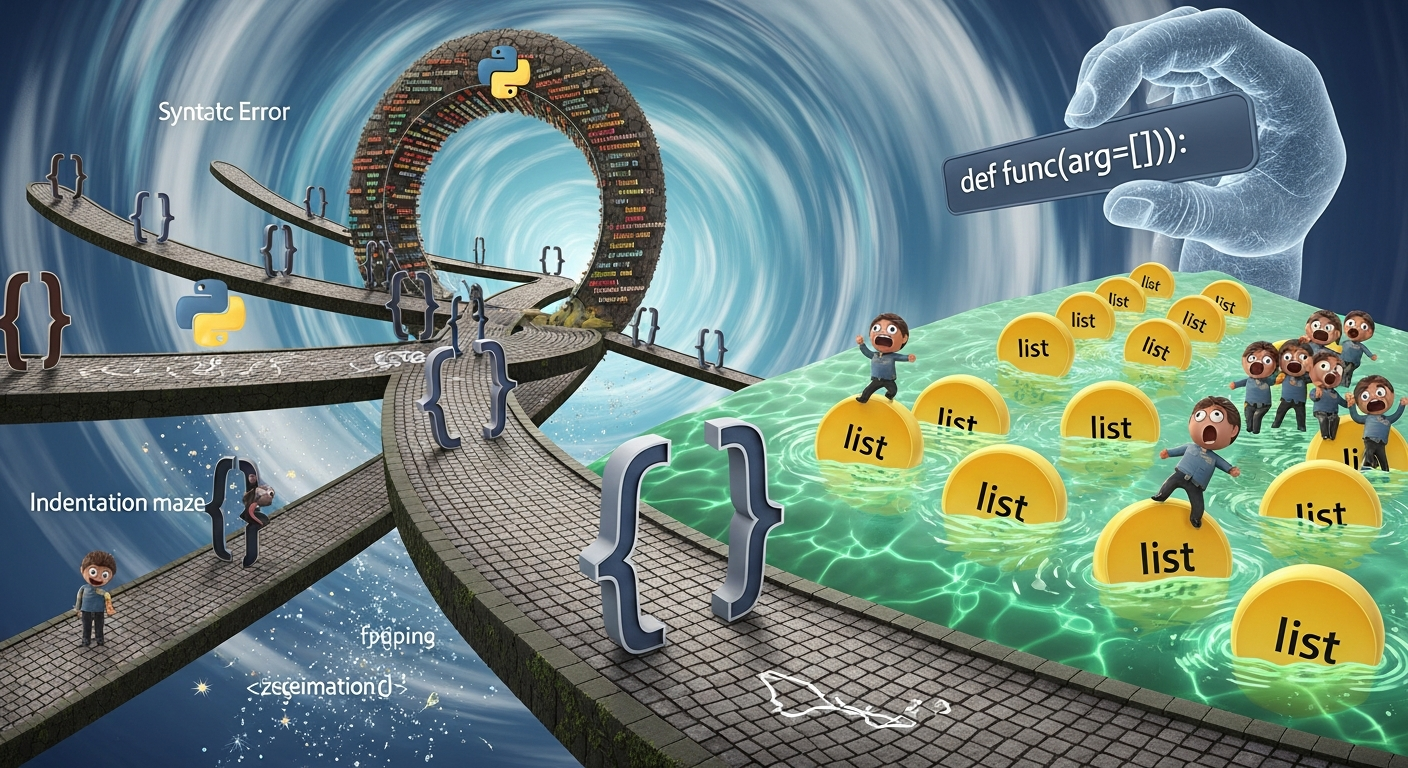
1. Indentation is King (and Queen): This is the big one. I'm coming from languages where curly braces reigned supreme, so Python's reliance on indentation for code blocks drove me nuts. I'd constantly get `IndentationError` and spend ages staring at my code trying to figure out what was wrong. Pro Tip: Get your editor to automatically convert tabs to spaces (usually 4 spaces), and be *super* consistent. Also, learn to love Ctrl+[, Ctrl+] (or their equivalent) for indenting/unindenting blocks quickly.
2. Mutable Default Arguments: Oh boy, this one is subtle and sneaky. If you use a mutable object (like a list or dictionary) as a default argument to a function, it gets shared between function calls. This means if you modify it in one call, it's modified for the next! I spent a good half-day debugging a function that was mysteriously remembering values from previous calls. Example:
def append_to_list(value, my_list=[]):
 my_list.append(value)
 return my_list

print(append_to_list(1))
print(append_to_list(2)) # Expecting [2], getting [1, 2]!
Instead, do this:
def append_to_list(value, my_list=None):
 if my_list is None:
 my_list = []
 my_list.append(value)
 return my_list

print(append_to_list(1))
print(append_to_list(2)) # Now it works as expected!
3. Variable Scope Gotchas: Coming from other languages, I initially struggled with variable scope, especially when dealing with global vs. local variables inside functions. Accidentally trying to modify a global variable without declaring it using `global` led to some cryptic error messages. My advice: Be mindful of where you define your variables and whether you intend to modify global variables from within functions.
4. Confusing `=` and `==`: This is a classic for any beginner, but it's especially easy to do in Python where code can be so concise. Accidentally assigning a value instead of comparing it in an `if` statement is a surefire way to introduce bugs. Double-check those equality checks!
5. Ignoring Virtual Environments: Okay, this isn't strictly a *Python* problem, but it's crucial for managing dependencies. I started off installing everything globally, which quickly led to dependency conflicts. Lesson learned: Use `venv` or `conda` to create separate environments for each project. It keeps things clean and prevents version clashes.
What are some other beginner traps you've encountered in Python? Share your experiences in the comments below!
 Notifications


Aucun commentaire pour l'instant.