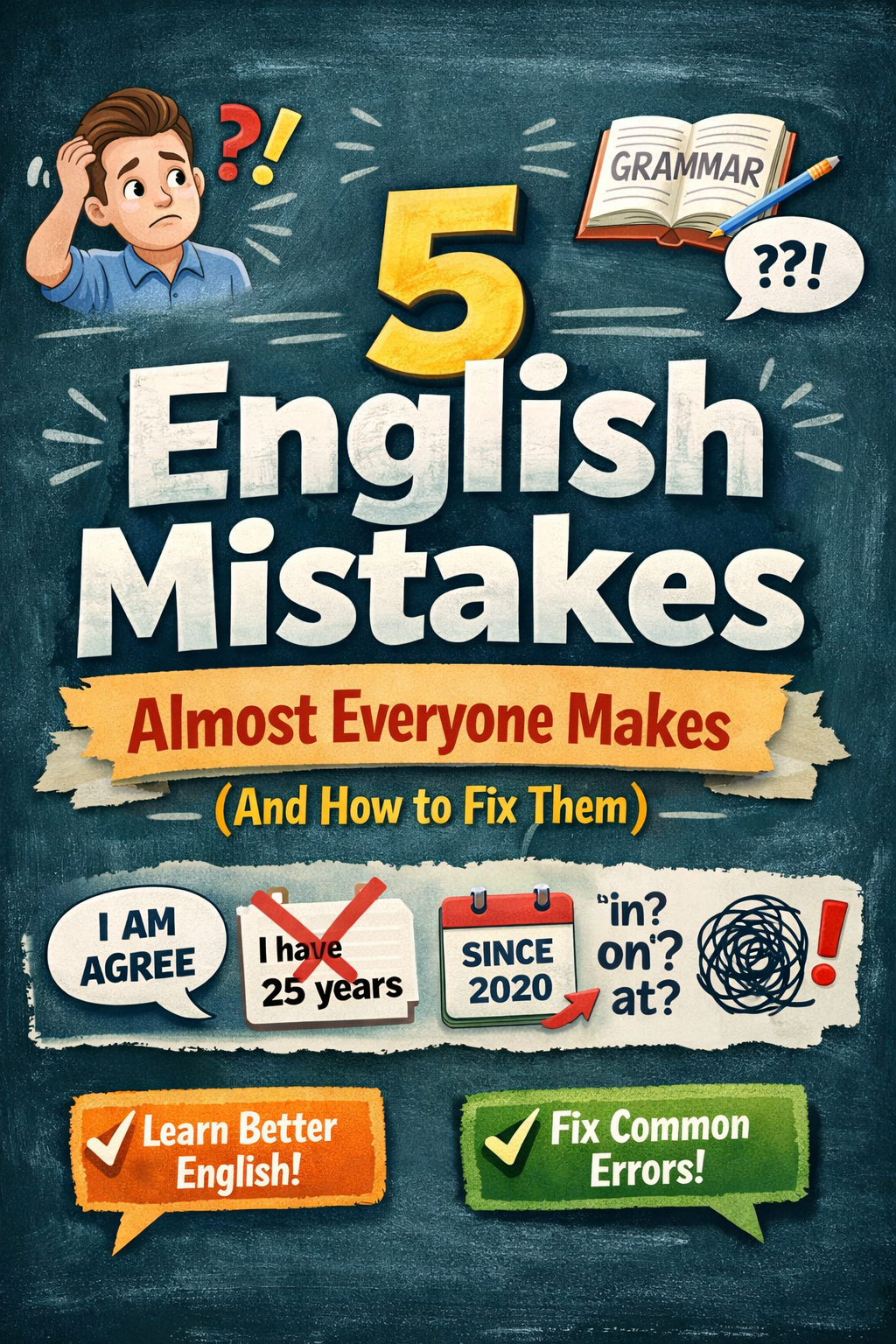
5 English Mistakes Almost Everyone Makes (And How to Fix Them)

Cet article présente les 5 erreurs les plus courantes en anglais que font presque tous les apprenants, même à un niveau intermédiaire. Il explique pourquoi ces erreurs apparaissent, souvent à cause de la traduction, et montre comment les corriger simplement. À travers des exemples clairs et pratiques, l’article aide les apprenants à parler un anglais plus naturel et plus fluide, sans stress grammatical inutile.
5 English Mistakes Almost Everyone Makes (And How to Fix Them)
Publicité
Introduction
If you are learning English, you are not alone in making mistakes.
In fact, almost everyone makes the same mistakes, even learners who:
- Know a lot of grammar
- Understand English well
- Can read and write without problems
The issue is not intelligence or effort.
The issue is that English works differently from many other languages.
Some mistakes are so common that teachers hear them every day, all around the world.
The good news is this:
These mistakes are easy to recognize, easy to understand, and easy to fix once you become aware of them.
In this article, you will discover:
- The 5 most common English mistakes
- Why learners make them
- Clear explanations with examples
- Simple and practical ways to fix them
- How to avoid translating from your native language
This article is written for intermediate learners who want to sound more natural and confident when speaking English.
Mistake 1: “I Am Agree” Instead of “I Agree”
The mistake
Many learners say:
- ❌ I am agree with you.
- ❌ I am not agree.
Why this happens
This mistake comes from direct translation.
In many languages (French, Arabic, Spanish, etc.), the word “agree” is an adjective, so people say:
- “I am in agreement”
- “I am agree” (logical in their language)
But in English, “agree” is a verb, not an adjective.
The correct form
In English, we say:
- ✅ I agree.
- ✅ I don’t agree.
- ✅ I agree with you.
There is no “am” before the verb agree.
More examples
Incorrect:
- ❌ I am agree about this idea.
- ❌ She is agree with the plan.
Correct:
- ✅ I agree about this idea.
- ✅ She agrees with the plan.
How to fix it
- Remember: agree = verb
- Use it like other verbs:
- I agree
- You agree
- He agrees
Practice tip
When you want to express opinion, use these natural phrases:
- I agree.
- I completely agree.
- I don’t really agree.
- I agree with you, but…
Mistake 2: “I Have 20 Years” Instead of “I Am 20 Years Old”
The mistake
Many learners say:
- ❌ I have 20 years.
- ❌ She has 25 years.
Why this happens
Again, this is a translation problem.
In many languages, age is expressed with the verb have:
- “I have 20 years” (logical in those languages)
But English does not use have for age.
The correct form
In English, we use the verb to be:
- ✅ I am 20 years old.
- ✅ She is 25 years old.
Often, native speakers even say:
- I’m 20.
- She’s 25.
More examples
Incorrect:
- ❌ My brother has 30 years.
- ❌ How many years do you have?
Correct:
- ✅ My brother is 30 years old.
- ✅ How old are you?
How to fix it
Think of age as a state, not something you own.
- Age = be
- Not have
Practice tip
Memorize these patterns:
- I’m ___ years old.
- He’s ___ years old.
- How old are you?
Do not translate from your language.
Mistake 3: “I Am Here Since 2020” Instead of “I Have Been Here Since 2020”
The mistake
Many learners say:
- ❌ I am here since 2020.
- ❌ I work here since last year.
Why this happens
This mistake is caused by:
- Confusion about tenses
- Translation from other languages
- Difficulty with the present perfect
English is very specific about time and duration.
The correct form
When an action:
- Started in the past
- Continues until now
English uses the present perfect.
Correct sentences:
- ✅ I have been here since 2020.
- ✅ I have worked here since last year.
Key words to remember
When you see:
- since
- for
- how long
You often need present perfect.
Compare
Wrong:
- ❌ I am married since 2018.
Correct:
- ✅ I have been married since 2018.
How to fix it
Use this formula:
have / has + past participle
Examples:
- I have lived here for five years.
- She has studied English since 2021.
Practice tip
Ask yourself:
- Is the action still true now?
If yes → use present perfect.
Mistake 4: Using the Wrong Prepositions (In / On / At)
The mistake
Learners often say:
- ❌ I am in the bus.
- ❌ See you in Monday.
- ❌ I work at home since two years.
Why this happens
Prepositions are:
- Small
- Illogical
- Different in every language
They cannot be translated directly.
The correct usage
Here are some essential rules.
Time
- At → specific time
- at 7 o’clock
- On → days and dates
- on Monday
- In → months, years, long periods
- in 2024
Examples:
- ✅ See you on Monday.
- ✅ I was born in 1999.
- ✅ The meeting is at 10.
Place
- At → point or activity
- at work, at school
- In → enclosed space
- in a room, in a city
- On → surface
- on the table
How to fix it
Do not try to understand prepositions logically.
Instead:
- Learn them in phrases
- Repeat them often
Practice tip
Memorize common expressions:
- at home
- on time
- in the morning
Mistake 5: Overusing Complex Grammar to Sound Advanced
The mistake
Some learners try to sound “advanced” and say:
- Very long sentences
- Complicated tenses
- Unnatural expressions
This often creates:
- Confusion
- Errors
- Stress while speaking
Why this happens
Learners think:
“If I use difficult grammar, my English is better.”
But in real life, simple English is powerful English.
The better approach
Instead of:
Had I been informed earlier, I would have potentially reconsidered my previous decision.
Say:
If I knew earlier, I would change my decision.
Native speakers prefer:
- Clear
- Direct
- Simple sentences
How to fix it
- Use simple tenses confidently
- Focus on clarity
- Speak naturally, not academically
Practice tip
Ask yourself:
- “Is this how people really speak?”
If not, simplify.
Why These Mistakes Are So Common
All five mistakes have the same causes:
- Translation from the native language
- Too much focus on grammar rules
- Not enough exposure to real spoken English
The solution is not:
- More grammar books
- More rules
The solution is:
- More listening
- More speaking
- More real examples
How to Fix These Mistakes Permanently
1. Learn phrases, not rules
Instead of learning:
- since + present perfect
Learn:
- I’ve been here since…
2. Listen to real English
Watch:
- Interviews
- Podcasts
- YouTube videos
Focus on how people speak, not grammar names.
3. Speak without fear
Mistakes are normal.
Silence is worse than mistakes.
4. Correct yourself naturally
Do not stop speaking.
Just correct and continue.
Final Conclusion
Making mistakes in English is normal.
Making the same mistakes forever is optional.
You do not need perfect grammar.
You need:
- Awareness
- Practice
- Confidence
If people understand you, you are doing well.
English is not an exam.
It is a tool for communication.
Speak first.
Improve later.
🎯 Learning Objectives
À la fin de cet article, l’apprenant sera capable de : Identifier les 5 erreurs les plus fréquentes en anglais parlé Comprendre l’origine de ces erreurs (traduction, logique de la langue maternelle) Utiliser les formes correctes et naturelles en anglais Améliorer sa fluidité à l’oral sans se bloquer sur la grammaire Gagner en confiance lors de conversations en anglais Réduire les erreurs répétitives dans son anglais quotidien
📚 Prerequisites
{{ article.prerequis }}
Don't miss the next update!
Join our community and get exclusive Python tips and DzSmartEduc offers directly in your inbox.
No spam, unsubscribe anytime.
💬 Comments (0)
No comments yet — be the first!
✍️ Leave a comment
Similar Articles
No articles to display yet.
 Notifications